

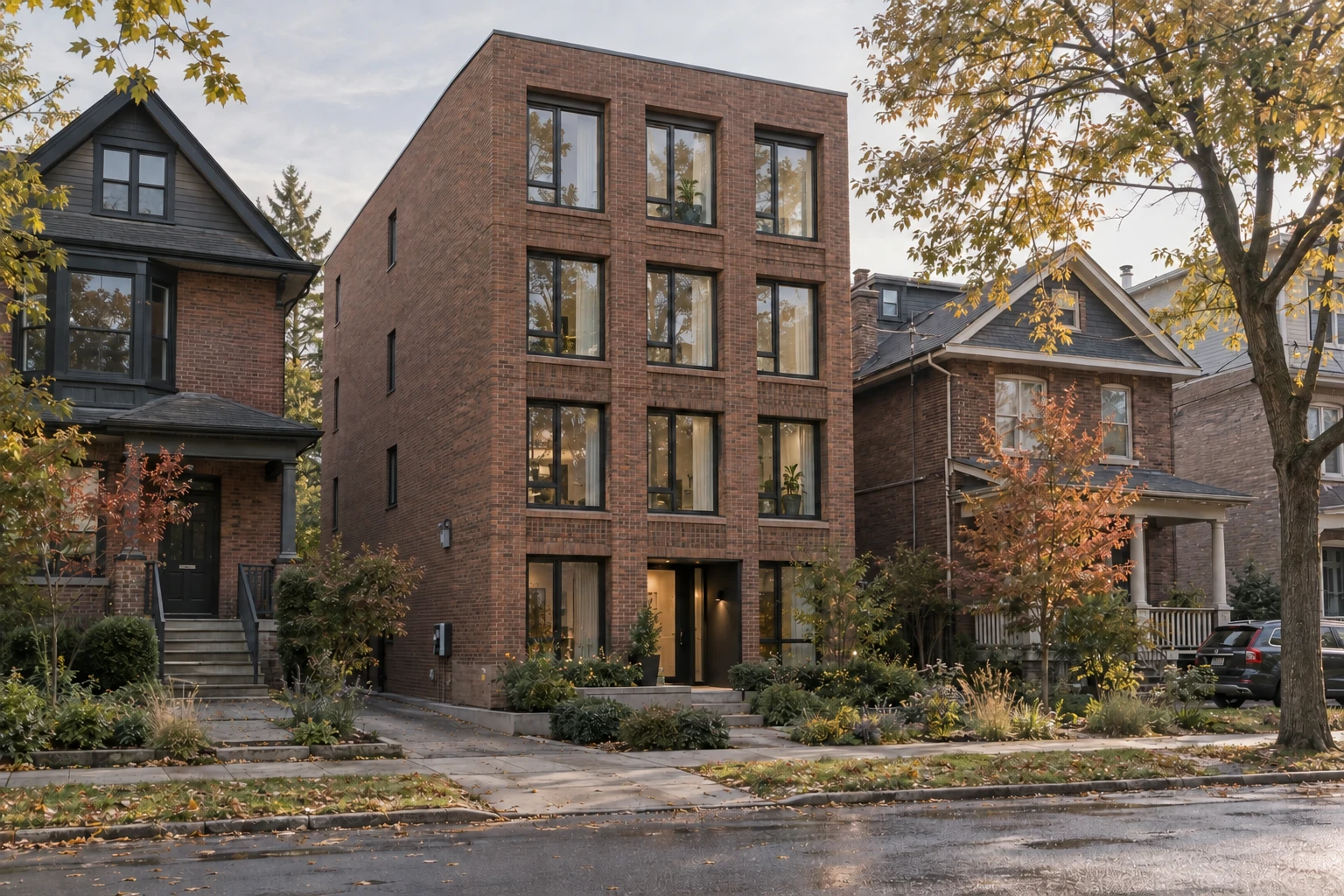
Start with unit count and occupancy
CMHC mortgage loan insurance can support lending through participating lenders. It is not a construction grant or a promise that a particular proposal will receive financing.
| Proposed situation | Route to discuss with a lender |
|---|---|
| Homeowner adding units, with no more than four total | Whether CMHC Refinance or another homeowner product fits the actual occupancy and project. |
| Rental property with at least five eligible units | CMHC multi-unit insurance, including standard rental housing and potentially MLI Select. |
| Main building and a separate rear suite | How the lender and insurer count and assess the whole property; do not assume eligibility from the physical unit total alone. |
Identify legal units, title, rental use and owner occupancy before comparing program limits. A fourplex example and a sixplex example may belong to different lending routes.
CMHC Refinance: an eligible homeowner route
CMHC Refinance supports eligible existing homeowners creating additional legal, self-contained units. The borrower or a qualifying relative must occupy a unit rent-free. The resulting property can have up to four units, including existing units.
The program allows up to 90% loan-to-value and a maximum 30-year amortization, with the as-improved lending value below $2 million. Additional financing must relate to the project. Short-term rentals of less than 90 consecutive days are not eligible, and approval must occur before construction or at an early stage.
These are program boundaries, not an approval. A lender must assess the borrower, property, scope and timing. Read CMHC’s current Refinance requirements before including this route in the funding plan.
Standard rental housing: five or more units
CMHC’s standard rental housing insurance is a separate multi-unit route for eligible projects with at least five units. It can apply to new construction and existing rental housing, subject to the applicable lending and borrower requirements.
Ask a lender to compare this route with MLI Select for the same project. The comparison should cover supported loan amount, required equity, debt service, amortization, fees, guarantees, borrower capacity and the timing of advances.
A financing product’s existence does not settle whether an owner has the required experience, management arrangement or financial capacity. Use the standard rental housing requirements to frame the discussion.
MLI Select: eligibility plus measurable commitments
MLI Select applies to eligible rental projects with at least five units. Its points system rewards qualifying affordability, energy efficiency and accessibility outcomes. A project needs at least 50 points; the commitments require evidence and are not simply labels added to a concept.
For qualifying new construction, published terms allow up to 95% loan-to-cost. Maximum amortization increases from 40 years at 50 points to 45 years at 70 points and 50 years at 100 points. Actual loan proceeds remain subject to underwriting and other limits.
Affordability is assessed against the program’s defined income measure, not simply a discount from an owner’s preferred rent. Review current MLI Select criteria with the lender and design team before choosing commitments.
Why the maximum loan is not the budget
A 95% loan-to-cost ceiling does not establish that the owner needs only 5% of every expenditure in cash. Eligible costs, valuation, debt-service capacity, advances and lender conditions all need to be reconciled with the project budget.
Keep operating assumptions visible. Net operating income is income after operating expenses; debt service is the loan’s payment obligation. For arithmetic alone, $110,000 of annual net operating income divided by $100,000 of annual debt service gives a ratio of 1.10. That calculation is not a financing approval or a forecast for your property.
Request a project-specific assessment showing the binding loan constraint, required owner contribution and any cash needed before or between advances.
Bring a defined project to the lender
Prepare the legal unit count, occupancy plan, preliminary design, full budget, rental and expense evidence, proposed schedule and borrower information. For MLI Select, identify which commitments the design and operating plan could actually support.
Ask the lender to confirm the applicable product and current requirements in writing. Coordinate its conditions with the design work before committing to a larger building or a particular affordability strategy.
Use the homeowner financing guide for the wider cash-flow questions and the sixplex guide to check the separate planning question.
Sources & scope
- CMHC: Refinance ↗
- CMHC: Refinance factsheet ↗
- CMHC: Standard Rental Housing ↗
- CMHC: MLI Select ↗
- CMHC: MLI Select factsheet ↗
General guidance for Toronto properties, based on the linked resources checked September 30, 2026. Public guidance and rules can change. Confirm the current applicable requirements for your address and design. These guides are not a permit approval, a site-specific feasibility finding or a contractor quote.